You already have enough to worry about when you travel for work, why make dressing well one of them?
Table of Contents
 Packing is terrible. Well, it’s terrible if you do it the way I used to do it.
I would wait until the last possible moment to pack, and then hurriedly shove whatever I could find into a carry-on. I would somehow end up with six shirts and only two pairs of underwear for a week’s trip.
 Nothing matched, and even though I thought of myself as a well-dressed guy, I always ended up looking like a schlub in front of important clients.
After the third late-night trip to a Target to buy underwear, I decided I needed a better strategy. I started where I always start with an intractable problem: Google.
One late-night google session and some critical thinking later, and this simple outline for repeatedly, consistently packing was born. I’ve since refined and perfected it so that it takes minimal time and provides maximum style points.
The basic strategy is simple enough: instead of packing from your closet every week, pack from a short list of things that can stand up to the rigors of travel, be chucked into a carry-on in a couple of minutes, and provides enough versatility that you can re-use it for weeks on end without repeating an outfit.
In return for the one-time effort of going through this editing process, packing light becomes automatic, you get 30+ minutes of your life back every trip you take — even more if it helps you to stop checking bags — and you always look good on the road.
There are some additional benefits to this sort of strategy once you get to your destination, too.
If everything in your travel wardrobe matches everything else, getting dressed in the morning is as simple as grabbing whatever’s on top of your suitcase, which leaves more brainpower for thinking about that important meeting at eleven.
Plus, by only needing a small number of durable, simple staples, you’ll naturally focus on buying quality over variety as your less-durable items wear out and need to be replaced.
What I’m ultimately talking about here is creating a variation on a capsule wardrobe. Born in the ‘70s, the idea comes from British boutique owner Susie Faux, who advocated owning just a dozen-ish basic items plus a few seasonally rotating pieces, not just for travel, but for life.
The core idea has been expanded and modified over the years, mostly by loosening the focus on minimalism and versatility—you can find “capsule wardrobes” with 25, 55 or even 70 different pieces of clothing, only some of which go with each other. Even Brock has a take on it, featuring 32 items.
I won’t tell you that if you have thirteen items in your travel wardrobe you’re suddenly doing it wrong, but thanks to the space requirements of a carry-on suitcase, we’ll be sticking pretty true to the core idea, and a dozen will remain our rule of thumb.
Time to get into the actual process of building your own travel capsule. It only requires five simple steps and about 45 minutes, starting with a step you already know how to do: packing like you normally would.
Before we do, as a note, the approach here is mostly geared towards guys who live the Road Warrior life, traveling for work regularly, to the same destination for many weeks at a time — think consultants, execs, and salesmen.
But whether traveling for work is a rare occasion or a weekly event, you can use this process once and never have to worry about packing again.
On with the show.
Step One: Gather a week’s worth of clothing options
Many of the guides on building a capsule wardrobe or travel packing list you’ll find around the web start with some platonic ideal of exactly what and how many of each thing you should have.
This is normally just whatever works for the writer of the guide, and it may not be what works for you.
Starting from someone else’s idea of perfect can have you dressing like someone you aren’t, forgetting things you need, packing things you don’t need, and generally never feeling like the end state is “right,” which makes you less likely to stick with it, which defeats the whole purpose.
Instead, start by just packing for a weeklong business trip. Include work clothes, workout clothes, underwear, after-work leisure clothes, and so forth. Anything you might need for a week away.
Do this quickly, and don’t overthink it. Err on the side overpacking slightly, even — give yourself some options, some backups, some things you only might need, whatever. We’ll be paring down the volume significantly in the next step, and it’s better to start the editing process with too much than too little.
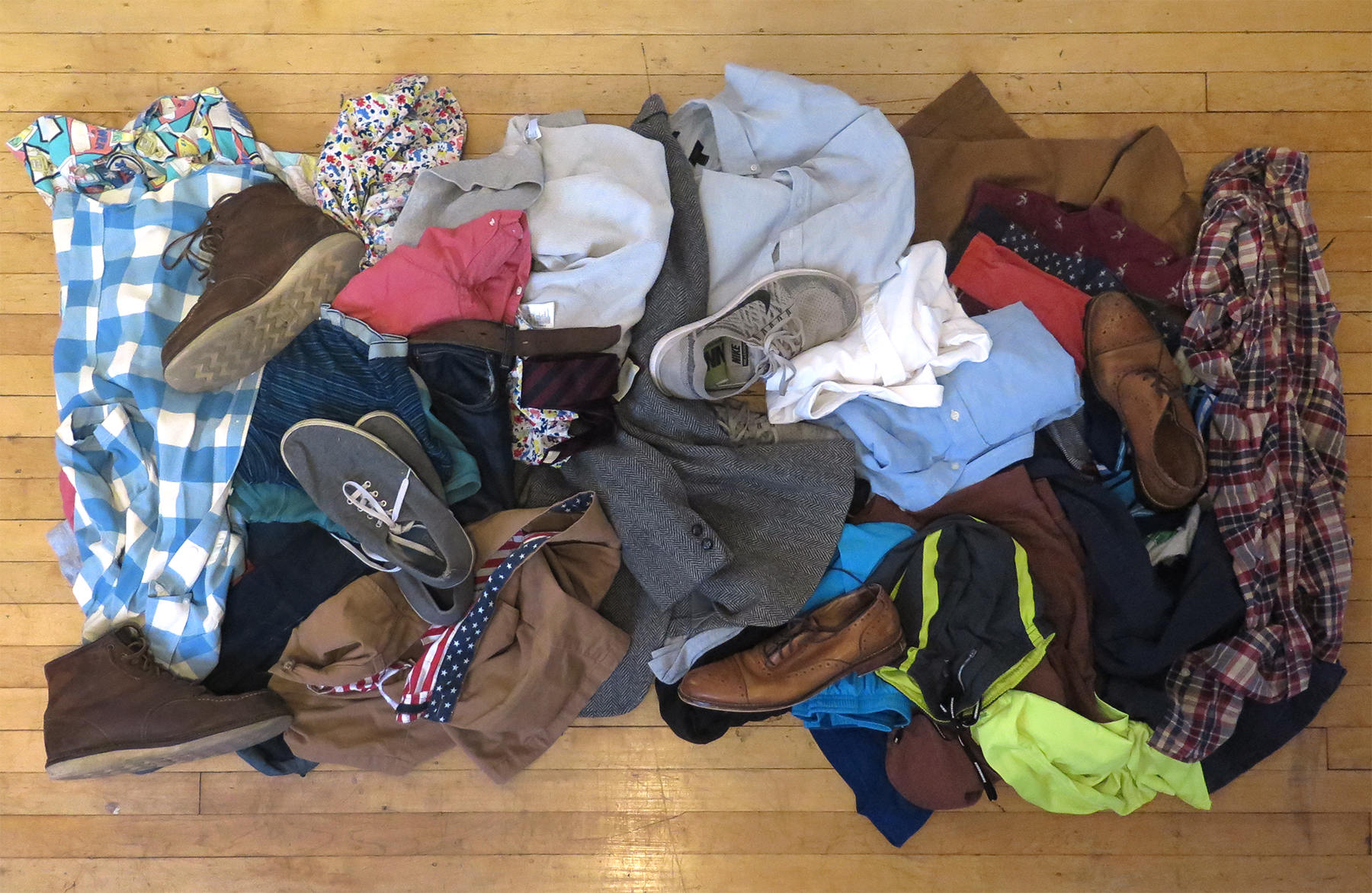
If you’re not doing this for a specific trip or destination, assume a slightly higher level of formality than you wear at your own office, and imagine the weather at your destination city is a generic spring or fall day in the midwest: mid 60’s, might rain but probably won’t.
Step Two: Remove Redundancy
In this step, you’ll be putting most of the clothes you just pulled out back in your closet, based on three criteria: everything you keep must be durable, versatile, and fit in a single carry-on bag.
Everything that you keep must meet these three rules. We’ll go over each before getting into some other recommendations about what’s worth keeping and what should stay at home.
Rule one: durable
The advice here is similar to any “build the core of your wardrobe” advice: if it won’t last, don’t bring it. Choose things that stand up to abuse well. If you travel regularly, you’ll be wearing these clothes as often as twice a week every week, and that means it’s not the time for that paper-thin H&M shirt.
Speaking of H&M shirts, pull all of your fashion-forward statement pieces too. You want items that will literally stand the test of time, but also classic pieces that are unlikely to go out of fashion soon.
The trick of a tiny mix-and-match travel capsule is to look well-dressed but largely uninteresting. This means keeping loud patterns, loud colors, and trendy cuts to a minimum.
I would even recommend culling patterns entirely and sticking entirely to solids.
The reasoning is twofold.
One, solids are easier to dress up or down as needed.
And two, no one is going to notice or care that you wore the same white shirt on Monday and Thursday, but they might realize they’ve seen a checked shirt before.
They still probably won’t care — assuming some baseline of cleanliness and presentability, you are always more concerned with what you’re wearing than anyone else is — but they might notice, and if that’s an unpleasant thought to you, solid colors are a good defense.
Again, well-dressed but largely uninteresting.
Rule two: versatile
Start making outfits. Match a shirt to some pants to some shoes, and repeat until you’ve gone through what you have.
Everything should go with everything else, and not just the ‘office attire.’ All of the shirts should match all of the pants should match a single choice of belt-and-shoes color.
Could you wear the t-shirt and
Questions like that are the secret to true wardrobe minimalism.
Think about it like a matching game — begin pairing off clusters of items and then adding to each one until you have groupings that all go well with each other. Start with the items that you only have a few of, like blazers or suits.
It helps to pick a color palette as an organizing principle here. One might emerge naturally, but if you have a lot of editing to do, just pick one.
I’d recommend either neutrals—brown/tan, gray, navy; brown shoes and belt—or monochrome—black, white, gray; black shoes and belt, just because it makes the matching game easier, especially when it comes to dress shoes and a belt (you should really only need one color of these).
Adding a single not-very-loud accent color to either one of those base palettes, like a burgundy or forest green, also works very well, especially if you have multiple clothing items (i.e. a shirt and a sweater) that are different shades of that same accent color.
Since you’re reading this on the Modest Man, I’m going to assume you’re already a sartorially-enlightened guy who doesn’t need me to repeat more general advice of creating outfits for your body-type that have compatible and flattering proportions.
But just in case, make sure all of your items match each other in this way too, not just in color.
Rule three: it’s all gotta fit into a single carry-on bag
You should now have a completely interchangeable travel wardrobe, or potentially several. Cut it down until what you have fills 3/4 of your carry-on suitcase.
If it’s more than 3/4 full, you’re not done removing items yet. Not “3/4 full when I roll everything tight and pack it in the perfect way,” either. 3/4 full when everything is rapidly folded and chucked in the bag.
If you have to spend an extra 5 minutes carefully rolling and arranging everything, you’re defeating the point of building a versatile, minimal, easy to deal with wardrobe.
When deciding what to pull, think about having slightly fewer of each item than you’d normally need for a week. It’s normally easiest to pull a pair of pants or a pair of shoes, but trading (for example) two checked shirts with one solid-colored one that can be worn twice is also an option.
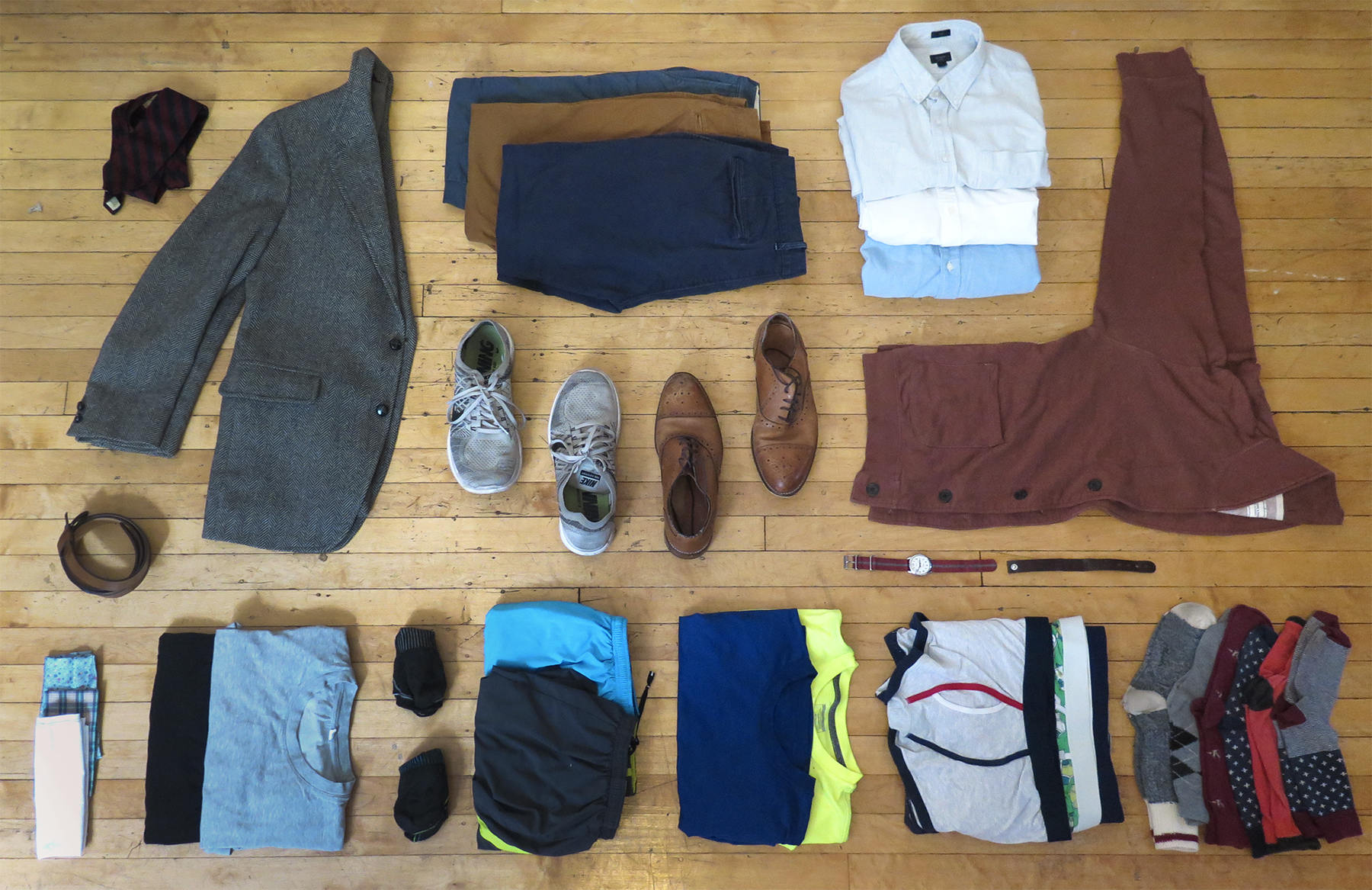
From a volume perspective, this should look something like:
-
-
- 2-4 pairs of pants
- 2-4 shirts
- 1-2 pairs of shoes
- 1-2 belts
- 1 sweater
- 1 blazer
- plus a couple of t-shirts, underwear, socks, athletic wear, a packable rain jacket, etc.
-
This is just a quick guess of a list based on a business-casual office. Depending on the formality of your office, you might end up with pants that are a mixture of chinos and jeans, or a bunch of slacks, if you’re a suits-at-work guy, it’s probably two suits instead of the shirts and pants, and so-on.
Even past that, you might like the idea of having a shirt for every day and prioritize it over more pants. Slacks are similarly variable in formality, quantity, and style. It all really depends on your needs and preferences.
Well, and the size of your carry-on suitcase. I won’t go too far down this rabbit hole, but it’s worth spending a bit of extra time and money to get a good suitcase that is exactly the maximum size that your preferred airline allows.
I prefer ballistic nylon with two rollerskate-sized wheels over four-tiny-wheel hardshell models, because they expand slightly, take damage more gracefully, and on the better ones, the two-wheel configuration allows for more clothing room.
Travelpro, Timbuk2, and LuggageWorks all have suitcases that meet these criteria at different price points (and include garment bag inserts if you’re bringing easily-wrinkled items).
A few more tips for removing redundancy
Here are a few bonus tips.
Layering is your friend
A heavy coat is bulky and unpleasant to lug around, and unless your destination is below freezing, you’d do better with one sweater and one blazer that can each be worn separately on cool days and together on cold days.
When going to places where it’s truly freezing, you can supplement this with a thinner coat that can easily go over one or both of the other layering pieces.
Even though you’ll most likely be wearing it in the airport and it doesn’t need to fit your suitcase, you’ll still be miserable dealing with a heavy coat, and one should only be brought if it’s absolutely arctic.
Choose things that can be dressed up and down
The best capsule wardrobes can serve a variety of settings, from a business-casual office to a more-formal sales meeting to a more-casual team dinner. As an example, make sure a couple of your shirts are button-collar oxford cloth numbers, which can be dressed-down easier than spread-collar poplin shirts.
Dark jeans, chinos and derby shoes with a cap toe and/or broguing have similarly versatile properties over things like flannel slacks and more-formal oxfords. Obviously you’ll need to adjust based on your office’s standard level of formality, but at least consider it.
Pick for space
All other things being equal, pick the thing that takes up less space.
This is especially true for shoes — stylish leather boots are wonderful, but some wingtips do the job just as well. In the same way, low-profile athletic
Step Three: Add Accessories
This is the Modest Man, after all. I wasn’t going to let you go into the world looking like a beige office drone.
Accessories provide uniqueness, variety, and originality without taking up much suitcase space — it takes much less space to always carry two weeks of unique accessories than two weeks of shirts.They also hide the fact that you’ve been wearing the same blazer all week.
Ties, pocket squares, watches, colorful socks, and a colorful knit belt are all great options, and if you’ve got the space, this is the time to even add back a “can only wear once a week” statement piece, like a pair of nantucket red chinos or a fun patterned shirt.
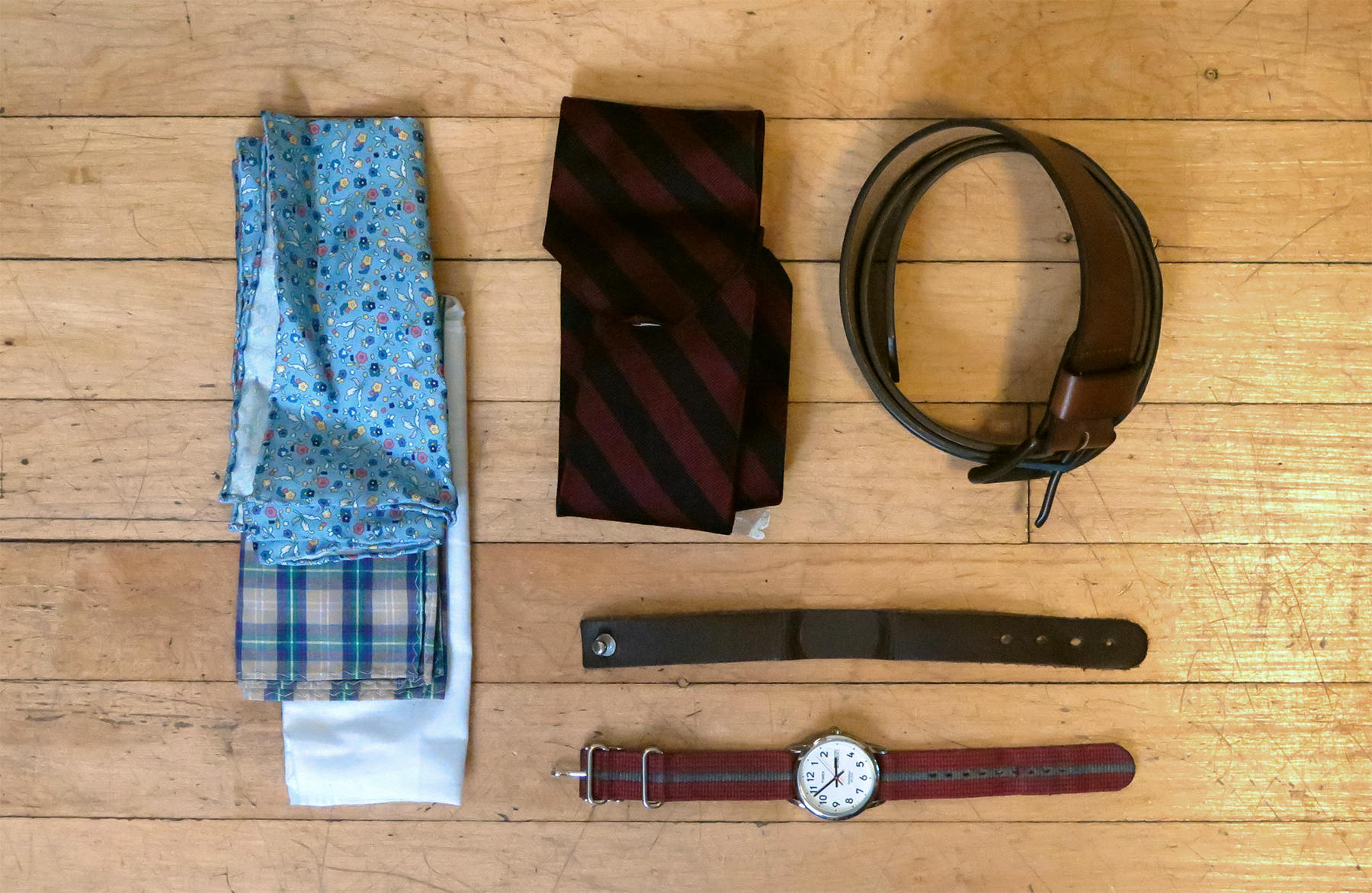
Think of this as a slot rather than a specific item, and feel free to change it up week-to-week.
Try not to fill the entire rest of your suitcase with accessories just because you can. You’ll still need some space for a toiletry bag, and it’s nice to not have a full-to-the-brim suitcase, if only so you can just chuck everything into it without careful folding at the end of a long week.
Step Four: Remove Redundancy, Redundantly
That’s right, step four is doing step two again. You should now have a preliminary capsule wardrobe laid out in front of you. Put it all into the suitcase once more, along with your toiletries, chargers, and other things you might bring, to make sure it all fits with room to spare.
If it doesn’t, go back to step two. Even if it does, consider everything carefully as an entire set, and attempt to remove 1-3 things in the interest of true minimalism and versatility. If you can’t, that’s fine—but don’t blow this step off. The exercise itself is worth it.
Some guiding questions as you examine your full kit:
Do you really need dress shoes,
Would the space taken up by that fourth pair of pants be better served by a second sweater or blazer?
Is there a substitution you could make that helps this collection be a more cohesive set?
Is it an appropriate level of formality?
If you’re an undershirt-under-dress-shirt person, do you have to be? Could it be time to get rid of that habit, for the good of your suitcase?
Do you have enough socks and underwear — enough for a standard trip length plus a day? Or did you forget to include those in your initial step? If you need to add them, do you need to remove something to make room?
Step Five: Revise Regularly
Technically speaking, after step four, you have a complete capsule wardrobe, ready to be taken on the road. Congratulations! But you might not have the right one for all of your work travel needs, and the only way to find that out is to travel with it.
Before you go on your first trip, make a quick list of everything that’s in the bag. This will serve as a time-saving checklist for the next time you pack and the reference document you can use to update your collection as needed.
Then, the next time you have to pack for a trip, just ask yourself: what worked? what didn’t? Did you have enough of everything? Did you not wear something, either because you packed too much or don’t actually like that thing?
Maintaining and updating this wardrobe should be an ongoing process, but an easy one. The point isn’t to never have pack again, it’s to be able to make all of these changes in 3-5 minutes as you put things in your suitcase because you have a standard set of decisions that you’re slowly evolving.
I had a few trips attempting this kind of strategy.
Then I realized that more shirts are more important than more pants, that an extra pair of underwear is very pleasant if your flight gets cancelled, and that if you pack things you think should “work” but you don’t actually like or feel comfortable in, you won’t wear them.
Also consider revising for variety, location, and seasonal appropriateness.
I personally have lighter-weight shirts and chinos that I switch in when I’m headed to warmer climates (sup, Atlanta in the summer), and I rotate through accessories like ties and pocket squares weekly, which helps me feel less boring week-to-week even though the base wardrobe is still 95%+ the same.
In practice: my exact capsule wardrobe
In case you’re having trouble visualizing what all this looks like in action, here’s my exact travel wardrobe and a week worth of outfits made from it.
This includes everything that I consider part of my ‘core’ travel packing list, and some notes about my reasoning around them, why I picked a given quantity, etc.
This is my wardrobe for when I worked on the creative/strategy side of a digital products consultancy (apps, websites, enterprise software), where the dress code ranges from a business casual to “whatever as long as you’re not wearing sweatpants and Crocs to work.”
You’ll notice that I trend towards business casual in this packing list even though I could have gotten away with less-formal attire, and that it specifically has a sort of New England preppy vibe.
The general reasoning behind staying at the top of my appropriate formality range is that it’s easier and even beneficial to be overdressed than underdressed.
If you’re a regular reader of the Modest Man, this shouldn’t be a surprising statement.
The reasoning behind the prep vibe is a little trickier. Mimicking a specific, well-known style lets me get away with wearing chinos and a blazer in the rare situation where everyone else is wearing a suit — “oh, he’s not underdressed, he’s got a look.”
Plus, I like the look, and what you wear should reflect your personality and preferences.
You’ll also notice that some of these pieces aren’t specific items but actually operate as slots.
I only make room for one blazer, but I have two that work in the wardrobe, and I snag whichever one I’m feeling when I put my suitcase together on Sunday. Everything works together, so it doesn’t matter which one I choose.
3 solid oxford-cloth button-downs — white, gray, french blue. You could get away with two, but I have the space for three, and it gives me more re-wear versatility.
3 pair chinos — navy, mid-blue, brown. Again, you could get away with two, or switching one for dark jeans, which I sometimes do when I’m working at more casual clients.
1 blazer — tweed or navy. Like I mentioned above, I only bring one at a given time, but I have two that could fit in the slot, just for variety.
1 sweater — I opt for a french terry shawl collar cardigan like this one, which layers under a blazer well, has more structure and shape on its own than a wool sweater, and is hoodie-comfortable. Like the blazer, I have two of these, in rust brown and gray.
2 gym shirts, 2 gym shorts, 2 pair gym socks — All of these are made of a quick-dry synthetic fabric. When I’m done being sweaty in them, I get in the shower with them, lightly wash them with the same Dr. Bronner’s Castile Soap I use for my body, and hang them over a towel bar to dry.
This lets me get away with two rotating sets, even if I go to the gym more than twice over the trip.
2 cotton t-shirts — one black, one gray. I sleep in (underwear and) these, and they also look pretty good with the chinos and
6 days of socks and underwear — Six because it’s one day longer than my longest normal trip. Just in case.
A few but not all of the socks are fun colors and/or patterns. Some folks opt for only a couple pair of antimicrobial “wash it in the sink/shower” underwear (ExOfficio is the brand I hear the most). I am not one of them, but it is an option.
1 packable rain jacket — This is one of those ones that self-stuffs into a small pouch. I specifically like Patagonia’s Torrentshell because the nylon they use doesn’t come out of the pouch looking crazy wrinkly.
1 quilted jacket — I only bring this when it’s actually cold. If I know it’s going to be absolutely arctic, I have a peacoat I’ll bring instead. For both occasions, the bulk is only worth it if you really need it.
1 pair derbys — brown leather. I sometimes switch these out for brown leather loafers or even clean, newish boat shoes at the peak of summer. If you have expensive shoes (I don’t care enough to), two pair that you rotate so that they can dry completely between wearing is not a bad thought.
1 pair Nike Free
1 tie — I only bring one, but rotate through a handful of diagonal stripe repp ties week-to-week.
3 pocket squares — I’ve got about a dozen of these that I rotate as well. Half are neutral colors and half are loud patterns.
1 lapel flower — It’s a fun and compact non-pocket-square blazer accessory.
1 brown leather belt — Nothing special here, it’s just a belt. It matches the shoes.
1 watch, 2 bands — Instead of bringing multiple watches, I opt for a NATO-strap style watch and two or three different bands for it, one colorful and one muted.
And there you have it.
This exercise can have some interesting impacts on your non-travel life, too. You may find, like I did, that over time this minimal wardrobe philosophy begins carrying over to your non-travel wardrobe, and then to all of your stuff.
After I spent a couple years traveling every week with basically this wardrobe, I came home to my well-appointed closet, thought “I don’t wear any of this stuff!” and got rid of a vast majority of it.
I did the same with old electronics and other cruft that wasn’t important enough to pack and never saw use on the weekend.
These days, my entire wardrobe is only roughly the above list doubled, plus some more activewear, a couple of suits, a couple of things for wearing to my sports teams’ games, and some t-shirts/jeans/sneakers/boots for weekends.
If anything sits in my closet for more than 12 months without being worn, it goes directly to a donation bin.
Just remember, can I get away with not having this? is a much better question to constantly be asking yourself than could I need this someday?
Thoughts? Questions? Leave a comment below!






Does your list (and quantities) include what you are wearing on the flight, or are they in addition to?
Great question!
The list does not include the clothes that I wear when I fly. You could certainly get away with slightly less by wearing one of the outfits onto the plane (especially if you’re going straight to the office from your flight), but I prefer to have a specific ‘travel uniform’ that I wear whenever i’m in airports. I literally only wear it while in transit (to and from, wash on the weekend), and because of that, it doesn’t count towards suitcase space nor does it count as something I wear to work while I’m on site.
Having a travel uniform is a comfort and consistency thing for me — I like to travel on as close to full autopilot as possible, and that means routine, routine, routine.
Wearing the same clothes every time removes one more choice that I have to make, helps me get into an “I am traveling” mindset, and sets me up for a more comfortable, consistent travel experience. There are plenty of other things that can go wrong while I travel, I don’t need to make uncomfortable or unfamiliar clothes one of them.
My specific travel uniform: black t-shirt, jeans, mid-weight unstructured blazer, desert boots or boat shoes. I don’t look out of place in a first-class lounge, but I also don’t look like a CEO. I’ll sometimes sneak the blazer or boots into the week’s rotation, but having a consistent travel uniform is more important to me than using what I wear on the flight as ‘bonus clothes,’ so it’s not my first priority.
Hope that helps!
Your barn door is open in one of the pictures…
¯\_(ツ)_/¯
What is the brand and name of the boots in the picture with all the clothes?
Those are Red Wings, a brand I know Brock has recommended in the past. Specifically, they’re the “Classic Moc” #1907.